News
Marine Spatial Planning in Grand-Bassam
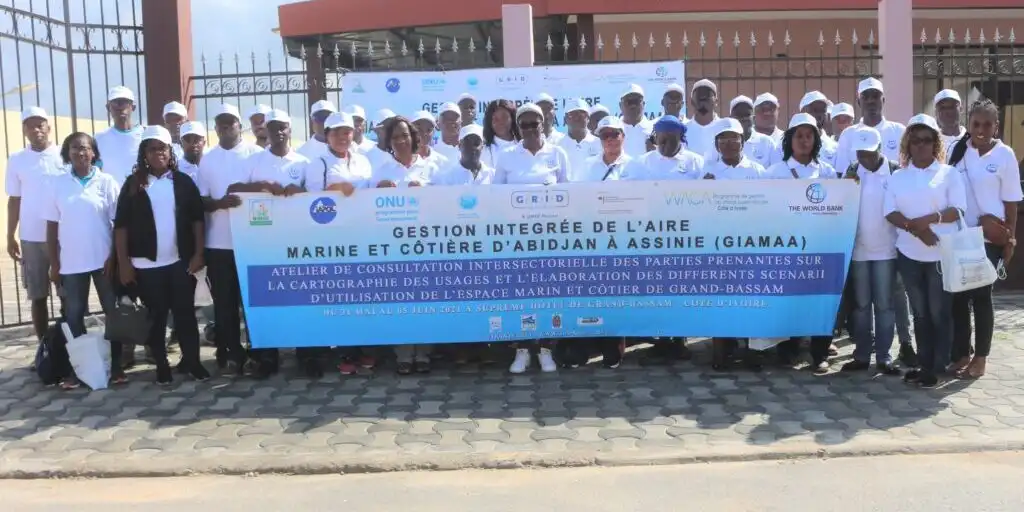
Over six days, more than sixty environmental experts conducted discussions during the intersectoral stakeholder consultation workshop on the mapping of uses and on the development of various scenarios for the use of marine and coastal space in Grand-Bassam. This workshop, chaired by Mr. François Kouablan, Chief of Staff representing the Minister of Environment and Sustainable Development, Mr. Jean-Luc Assi, took place from May 31 to June 5, 2021 in Grand-Bassam.
The intensity of human activities is not without negative impacts on the marine and coastal environment of Côte d'Ivoire. The need to have a plan for the development of the marine and coastal space of Côte d'Ivoire is more than urgent. This is why the choice fell on the first capital of Côte d'Ivoire, a pilot city for Marine Spatial Planning (PSM), which is a tool for managing marine and coastal space. CIAPOL, a national technical structure, was responsible for implementing the project.
During the workshop, several communications and group work allowed the development and validation of maps of future uses, as well as scenarios for the evolution of the marine and coastal space of Grand-Bassam. For this purpose, several field visits were carried out during the workshop.
Recall that the project coordination team identified the sites and set up a multi-dimensional scientific team responsible for leading the process in March 2021. Subsequently, the first intersectoral consultation for the identification of all stakeholders in the marine and coastal space of Grand-Bassam was held, followed in July 2020 by the call for applications for the recruitment of a consultant responsible for evaluating the legal and institutional framework of Côte d'Ivoire in terms of MSP. In September 2020, training on the use of the SEASKETCH mapping software was provided, followed in November 2020 by the development and validation of the PSM report plan, while a stakeholder capacity building workshop on PSM was held in February 2021 in Bonoua.
Despite these significant advances in the PSM process, it must be recognized that many challenges remain to be met. This is demonstrated by the next steps, which are the validation of the zoning proposal; the development and validation of the mapping of future uses, which require data collection from all stakeholders; the development and validation of the Grand-Bassam marine and coastal area management plan; or the validation of the report evaluating the national legal and institutional framework relating to PSM.
Recall that the PSM is a process in perfect coherence with the Integrated Coastal Development and Management Plan (PAGIL) executed by the Investment Project for the Resilience of the West African Coastal Zone (WACA — ResIP). Indeed, these two complementary tools aim to provide actors in the marine and coastal space of Côte d'Ivoire with a planning framework, favoring an integrated and inclusive approach to the use of the marine and coastal zone. One (the PAGIL) aims to develop the coastal zone, and the other (the PSM), the maritime space, which are two interdependent environments. At the end of the Grand-Bassam workshop, certificates of participation were given to all stakeholders who took part in this workshop.