News
News
Published on
2022 Apr 20Countries

Côte d'Ivoire
Thematic Areas
Forest BiodiversityEcosystem RestorationCôte d'Ivoire - AIP/ Experts are working on the removal of the Mount Nimba reserve from the list of World Heritage in Danger
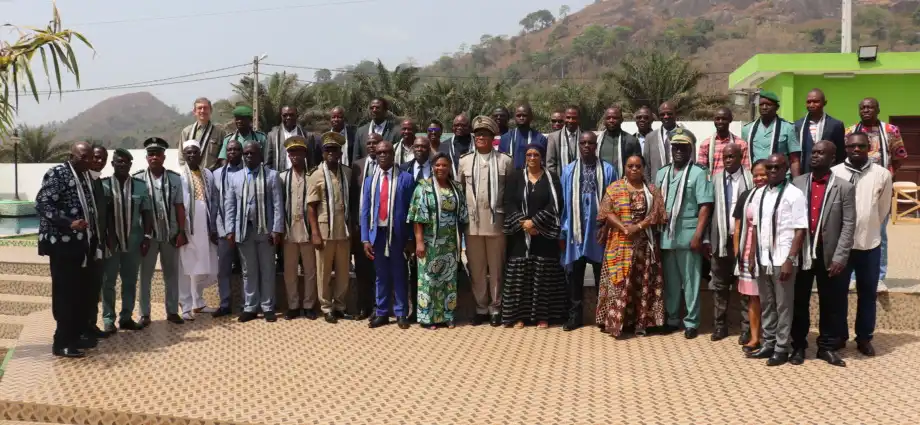
Man, Feb 10, 2022 (AIP) - Some forty experts and professionals in the field of World Heritage, from Côte d'Ivoire, Guinea and France, worked, from 07 to 08 February 2022, in a workshop in Man, on the implementation of the corrective measures issued by the United Nations Educational, Scientific and Cultural Organization (UNESCO) for the withdrawal of the Mount Nimic Integral Nature Reserve from February 7 to 8, 2022, on the implementation of the corrective measures issued by the United Nations Educational, Scientific and Cultural Organization (UNESCO). BA from the list of World Heritage in Danger.
The Mount Nimba Strict Nature Reserve, which was declared an integral reserve in 1944 by the colonial administration, has an area of approximately 19,500 hectares. This forest massif straddling Côte d'Ivoire, Guinea and Liberia was classified as a UNESCO World Heritage Site in 1982 for the Ivorian part because of its exceptional biodiversity. That of Guinea is placed in a biosphere reserve and world heritage while the part of Liberia does not yet benefit from a particular status.
This important reserve has unfortunately been placed as a World Heritage Site in danger since 1992 by the UNESCO World Heritage Committee mainly due to anthropogenic pressures and the existence of mineral exploration in its vicinity.
During the workshop, exchanges and debates between experts and professionals in the field of World Heritage from both States aimed at significantly addressing the corrective measures proposed and adopted by the World Heritage Centre and the International Union for the Conservation of Nature (IUCN) in order to permanently remove the common property from the list of heritage in danger.
According to the director general of the Ivorian Office of Parks and Reserves (OIPR), Tondossama Adama, in order to be able to extract the natural and integral reserve of Mount Nimba from the list of endangered heritage, several actions should be able to be implemented, namely, increased surveillance of the reserve to stop its destruction by local populations who “do not know the value of the space”.
Also, carry out ecological chemistry actions to better appropriate the capacity of space and what is. But also, establish a relational framework with the populations on the edge of the reserve by allowing the management of this space to have economic and financial benefits in their favor.
“It is a series of actions that has been defined with the International Union for the Conservation of Nature and the UNESCO World Heritage Center”, specified Mr. Tondosama.
The Secretary General of the Guinean Ministry in charge of the Environment and Sustainable Development, Fatou Diallo, expressed her country's willingness to work and go a little further in the conservation of the reserve in impact studies and resource mobilization to try to improve co-management and preserve the common environment.
Representing the Minister of National Education and Literacy, the Prefect of the Region, Prefect of the Department of Tonkpi, Attri Jean Cyrille welcomed the participants for the quality of their contribution to the workshop.
He underlined the importance attached by the minister of the workshop because for her, “the preservation of world heritage must be a priority of the States Parties to the Convention, and even a civic duty for every citizen”.
Côte d'Ivoire ratified the Convention for the Protection of Cultural and Natural Heritage on January 9, 1981. It registers five properties included on the World Heritage List, namely, the city of Grand-Bassam (2012), the Sudanese-style mosques in the north of the country (2021), the Comoé National Park (1983) and the Taï National Park (1983) and the Taï National Park (1981) and the Mount Nimba integral reserve.
Published on
2022 Apr 20Countries
Côte d'Ivoire