Document
Document
Variability of the functional traits of tree species in the reconstitution of the vegetation of Azagny National Park (Côte d'Ivoire)
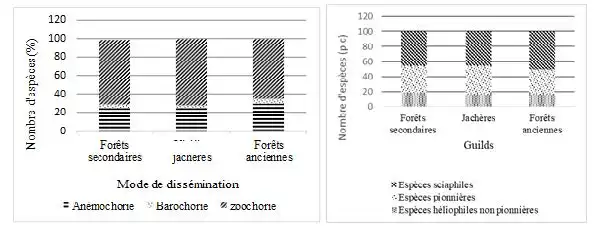
In the Azagny National Park, plantations of perennial crops were abandoned, some destroyed as well as habitats successively in 1986 and 2000. Therefore, all the vegetation in the park consists of relics of ancient forests, secondary forests and fallow lands of different ages. The present study evaluated the changes in the functional traits of tree plant species in different formations of Azagny National Park. Specifically, the aim was to: describe the life traits of tree species and compare the functional composition between ancient forests, secondary forests and fallow areas of 19 and 33 years. The leaf type, the mode of dissemination and the tolerance to light were recorded for tree-like individuals with a diameter of ≥ 2.5 cm recorded in plots of 0.25 ha. The functional spectrum of the species was determined and Kruskal-Wallis tests made it possible to compare the functional composition between these formations. The study of functional spectra carried out on 1972 individuals of trees, divided between 127 species and 46 families, showed a dominance of species with mesophyllous and macrophyllous leaves, sciaphilous species and zoochory in each of the biotopes. The Kruskal-Wallis tests showed significant differences in the functional composition of habitats in terms of megaphyllous, pioneer, barochore, and zoochoric trait modalities. This work reveals a return to initial ecological processes, and therefore a good reconstruction of disturbed environments, which will be facilitated by strengthening protection measures.